

Real‑World Performance of 3 mm ACM
Total panel thickness alone cannot determine fitness‑for‑purpose. Multiple variables govern real‑world behaviour: aluminium skin gauge, alloy grade, core composition, surface coating, physical dimensions, manufacturing tolerances, fabrication quality, mounting‑support spacing, applied loads, environmental exposure and valid test documentation.
Maintain consistent measurement units across construction drawings and purchasing paperwork.
Explicitly confirm overall panel thickness, individual aluminium skin thickness, core variant, finish gloss level, colour scheme and surface protective film.
Match span dimensions and fastener layout against wind‑load figures, impact risk, site‑handling stress and fabrication requirements.
Approve physical reference samples; cross‑check delivered production batches against agreed technical specifications.
Project‑specific engineering assessments, local building regulations, official test reports and supplier documentation take precedence over general descriptive data.
How to control quality of Aluminium Composite Panel 3mm

180° peel test: No delamination between aluminum skin and core

Boiling water resistanImmerse panel in boiling water for 2 hours, check for blistering or delamination.
 Coating thickness test:PE coating:≥20μm;PVDF coating:≥25μm

Color difference test, ΔE ≤ 2.0 under D65 light source.


Core Conclusions for Specifiers
--Three‑millimetre aluminium composite material balances low mass with solid mechanical performance; it exhibits good resistance to denting and bending while coping with fluctuating outdoor weather conditions.
--Its layered sandwich construction combines outer aluminium facings and a polymeric core, granting deformability, impact absorption and extended operational lifespan.
--It performs reliably for wall finishing, sign systems and interior fit‑outs; machining and custom shaping can be completed without excessive effort.
--Heavier‑duty applications demand thicker composite grades. Locations governed by strict fire codes need mineral‑filled flame‑retardant core options; demanding external environments also benefit from increased panel thickness or fire‑rated variants.
--Planned periodic surface cleaning preserves visual quality. Prompt repair of local indentations safeguards aesthetics and maintains long‑term functional capability.
Mechanical Performance of 3 mm Aluminium Composite Sheets
Load‑Bearing Behaviour
Relative to its low areal weight, 3 mm ACM offers respectable load‑carrying capacity. At 3‑8 kg/m², manual lifting and site installation are straightforward. Even with this low mass, mechanical characteristics remain competitive; the outer aluminium skins achieve tensile figures up to 250 MPa, meaning the material tolerates significant pulling stress without fracture.
Builders benefit from this favourable strength‑to‑weight ratio. The 3 mm overall dimension helps retain flat geometry under wind‑induced pressure. Within high‑wind zones, these panels deflect noticeably less than thinner composite alternatives. The dual‑aluminium‑skin plus polymeric‑core sandwich design distributes stresses efficiently, proven within building facades and large‑format commercial signage, maintaining stable performance over decades.
Bending / Flexural Behaviour
Flexural performance quantifies how much deformation a panel can withstand before cracking or permanent shape change. For standard 3 mm aluminium composite material, flexural strength falls within 83‑100 MPa. Such values permit controlled flexing without surface cracking or permanent distortion.
| Panel Thickness (mm) | Flexural Strength (MPa) |
|---|---|
| 3 | 83‑100 |
Corresponding flexural yield strength reaches approximately 26 ksi, alongside a flexural modulus of 1700 ksi. These metrics underpin stable flat geometry under distributed loads. For facade cladding and sign‑panel installations, this characteristic eliminates rippling and local indentation - critical for projects prioritising visual consistency alongside durability.
Contemporary production techniques further enhance flexural performance. Tightly controlled skin‑thickness tolerances and high‑end surface coatings minimise twisting, bending‑related distortion and weather‑driven degradation, expanding viable deployment into more demanding site conditions.
Impact‑Absorbing Properties
3 mm ACM performs well against blunt‑force contact. Charpy impact lab evaluations demonstrate substantial energy‑absorbing capacity prior to material failure. Its composite architecture resists dents better than monolithic solid aluminium sheet of comparable weight.
--Hail strike and flying‑debris contact rarely create permanent indentations.
--Modern surface finishes block ultraviolet radiation, moisture ingress and corrosion, preserving mechanical performance under harsh weather.
--Low areal weight permits large single‑panel formats without worrying about gravitational sag or thermally‑triggered warping.
Real‑world case examples confirm this behaviour. Certain commercial 3 mm ACM product lines successfully completed rigorous accelerated‑ageing testing; long‑term field deployment showed no warping or cracking. Fabricators and artists frequently select this material for variable‑climate exposure. Well‑known industry brands deploy 3 mm composite sheets for cladding and sign systems, where impact tolerance and flatness are non‑negotiable.
These panels also cope well with high‑wind scenarios. Combined layer action plus folded edge detailing minimises deflection, cementing its status as a popular candidate for externally‑faced building components exposed to strong wind forces.
Internal Build‑Up: What Defines Panel Robustness
Core Material Options
The inner core forms the functional heart of every 3 mm aluminium composite sheet. Most commodity panels deploy polyethylene (PE) polymer sandwiched between two thin aluminium facings. PE core keeps unit mass low, supports simple handling and preserves panel flatness. Where fire‑safety requirements apply, mineral‑rich cores incorporating aluminium hydroxide or magnesium hydroxide come into play. These mineral‑filled formulations slow flame spread and suppress smoke output - essential for high‑rise towers and publicly‑accessible buildings.
Common core‑material categories
Polyethylene (PE): Lightweight, easy‑to‑form; limited intrinsic fire‑retardant capability.
Mineral‑based fire‑retardant core: Building‑code‑compliant, slows fire propagation, cuts toxic smoke emission.
Honeycomb‑structured core: Deployed for niche projects targeting maximum stiffness with minimal added mass.
Core selection directly influences low‑temperature toughness, heat‑response behaviour and fire classification. Mineral‑filled grades retain good mechanical properties even under extreme cold; some achieve the A2 European fire‑safety classification required under stringent building‑code regimes.
Representative mechanical figures (mineral‑core ACM, tested per ASTM standard protocols):
| Property | Test Standard | Measured Result |
|---|---|---|
| Flexural Strength | ASTM D790‑10 Procedure A | 143 MPa |
| Flexural Modulus | ASTM D790‑10 Procedure A | 21130 MPa |
| Shear Strength | ASTM D732‑10 | 33.1 MPa |
| Tensile Strength | ASTM E8/E8M‑11 | 52.2 MPa |
| Heat‑Deflection Temperature | ASTM D648‑07 Method B | 107 °C |
Panel Manufacturing Architecture
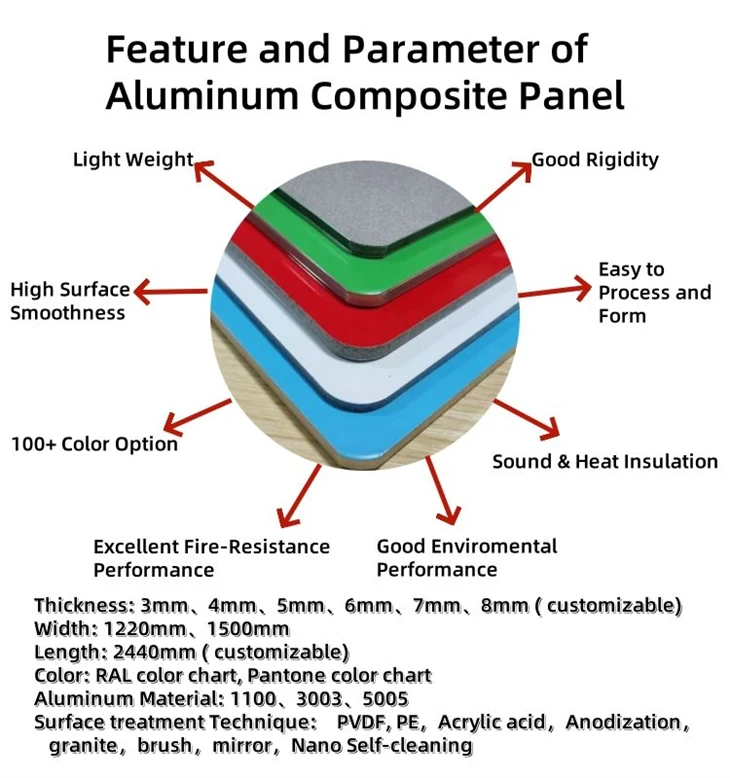
Three‑millimetre aluminium composite uses a classic sandwich layout. Two thin aluminium skins (0.2‑0.5 mm individual thickness) enclose the core medium, permanently bonded via high‑performance adhesive systems. This construction delivers the blend of stiffness and formability for which ACM is recognised. Outer aluminium facings defend against denting and bending stress; the inner core contributes thermal buffering and maintains low overall weight.

Standard production workflow follows these sequential stages:
1.Surface degreasing and thorough cleaning of aluminium coil stock
2.Chemical pre‑treatment layer to boost corrosion resistance and paint adhesion
3.Application of weather‑resistant UV‑stable top‑coat finishes
4.Heat‑and‑pressure lamination to fuse aluminium facings onto the core substrate
5.Controlled cooling cycle, application of temporary protective peel‑off film
6.Cutting‑to‑size and final packaging for shipment
This structured process delivers consistent quality and long‑term field durability. The sandwich design allows sawing, routing and punch‑press operations for diverse end‑uses while retaining structural integrity even under demanding operating environments.
Outer aluminium layers deliver impact defence and long service life
Inner core dissipates applied energy, balancing rigidity with controlled flexibility
Suitable for building wall cladding, interior fit‑outs and transport‑sector fitments including bus and train interior panels

Typical Project Use‑Cases & Practical Constraints
Main Application Sectors
Thanks to its favourable weight‑strength profile and durability, 3 mm ACM finds widespread industry adoption. Office and hotel curtain‑wall systems, airport terminals and exhibition‑hall envelopes all leverage its capacity to resist rain, solar radiation and wind loads. Interior deployments include feature wall systems, suspended ceiling assemblies, elevator lobbies and public‑area corridor linings to achieve contemporary visual aesthetics.
Sign‑making businesses rely heavily on this material for outdoor signage, logo panels, billboard substrates and illuminated light‑box structures, benefitting from outstanding surface flatness, colour fastness and form‑flexibility. Industrial applications encompass vending‑machine casings and equipment protective housings, leveraging corrosion‑inert properties.
| Application Segment | Representative Installations | Key Performance Requirements |
|---|---|---|
| Building Curtain Envelopes | Office towers, hospitality venues, airport terminals, exhibition halls, industrial premises | Low weight, high mechanical strength, anti‑corrosion, weather stability, fire‑performance compliance |
| Interior Architectural Finishes | Feature walls, suspended ceilings, elevator lobbies, public‑access corridors | Visual customisation potential, simple cleaning, minimal ongoing maintenance |
| Commercial Signage & Branding | Exterior signs, corporate logos, billboards, light‑box substrates | Superior flatness, outdoor stability, custom‑formable, colour retention, deformation resistance |
| Industrial Equipment Enclosures | Vending‑machine shells, elevator casings, machinery protective housings | Material safety, corrosion resistance, straightforward machining capability |
For coastal installations subject to salt‑laden atmospheric conditions, specify marine‑grade aluminium alloys to mitigate salt‑atmosphere degradation and extend service lifespan.
1.Installation complexity is reduced compared with steel or concrete cladding solutions
2.Light panel weight cuts logistics expenditure and on‑site labour outlay
3.Low maintenance requirements lower long‑term repair and upkeep expenses
Maintenance guidance: Every few years, clean panel surfaces using mild detergent mixed with water, using soft cloth materials to preserve finish quality.
Important Limitations to Consider
3 mm ACM possesses practical boundaries. Excessive concentrated loading may produce sagging or local bending. Where heavy static loads apply, switch over to steel or thicker composite‑panel alternatives. When compared against solid‑rolled aluminium sheet or honeycomb composite panels, 3 mm ACM demonstrates greater deflection under equivalent load. Large‑span sign faces or wall assemblies need adequately‑spaced sub‑framing to uphold flat visual geometry.
Steel exhibits higher inherent stiffness, with correspondingly greater mass and higher installed cost. Both 4 mm and 6 mm ACM grades show incremental improvements in wind‑load resistance; nevertheless, adequate sub‑structure support remains mandatory for large‑scale installations regardless of panel thickness.
From a cost perspective, 3 mm ACM carries higher upfront material cost than timber or vinyl alternatives. Volume‑based purchasing brings per‑unit price reductions, yet costs will still exceed certain competing substrate materials.
Recycling creates further practical challenges: merging aluminium metal with polymeric core complicates material recovery workflows. While innovative recycling technologies are emerging within industry, significant volumes still go to landfill. Projects prioritising circular‑economy outcomes should investigate specialist recyclable composite formulations.
When specifying 3 mm aluminium composite panels you acquire a lightweight yet robust substrate able to endure variable outdoor climate conditions, withstand moderate impact and resist atmospheric corrosion plus UV degradation. Installation workflows are relatively efficient, alongside broad aesthetic customisation options.
--3 mm ACM best fits interior environments plus moderately‑stressed external installations
--Select thicker‑gauge or mineral‑filled fire‑retardant ACM for high‑rise construction and sites subject to stringent safety‑code rules
| Panel Variant | Recommended Deployment Scenarios |
|---|---|
| 3 mm Aluminium Composite | Interior fit‑outs, moderate‑stress external projects |
| 4 mm / 5 mm Aluminium Composite | Exterior building envelopes needing enhanced mechanical performance |
| Fire‑Retardant ACM | Sites with mandatory fire‑safety regulatory demands |
Frequently Asked Specifier Questions
What magnitude of load can a 3 mm aluminium composite panel sustain?
Three‑millimetre ACM handles light‑to‑moderate distributed loads effectively. It maintains stable flat geometry for cladding and sign‑panel duties. Heavy point‑loading scenarios or oversized panel formats require supplementary sub‑frame support structures.
Can you readily cut and profile 3 mm aluminium composite sheets?
Standard workshop‑grade tooling including circular saws, router equipment or heavy‑duty utility knives achieves clean cuts and forming without panel cracking or splitting. Appropriate personal protective safety gear must be worn during all machining activities.
Does 3 mm aluminium composite material deliver waterproof performance?
The aluminium facings plus factory‑applied top‑coat deliver excellent water‑repellent characteristics, blocking rain‑water penetration. For external applications, seal all exposed cut edges to stop moisture wicking into the core substrate.
Will 3 mm ACM suffer rust‑related degradation?
Unlike ferrous steel, aluminium does not generate rust‑type oxidation. Even persistently damp environmental conditions leave panel surfaces largely intact.
Is on‑site painting or decorative finishing feasible for 3 mm ACM panels?
Surface over‑coating is achievable, provided you select paint formulations purpose‑engineered for metallic‑substrate application. Properly prepared surfaces hold paint reliably with minimal risk of peeling. Self‑adhesive vinyl graphics and decals can also be applied onto finished panel faces.
Hot Tags: aluminium composite panel 3mm, China aluminium composite panel 3mm manufacturers, suppliers, factory, aluminum acp, aluminum composite acm, composite panel sheet, Non combustible A2 ACM Panels, PVDF NANO Aluminum Composite Panel, Wood And Marble Grain ACP