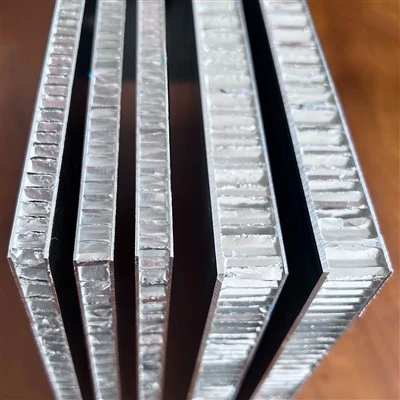
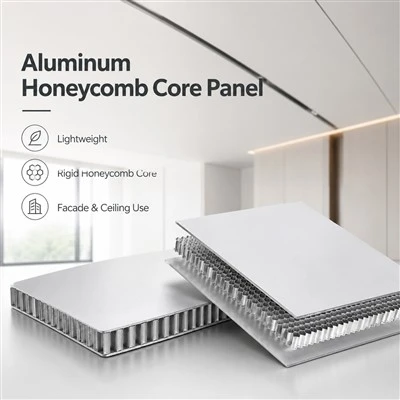
Aluminum honeycomb panels, with their advantages of being lightweight yet strong, providing sound and heat insulation, excellent flatness, and durability, are increasingly widely used in curtain walls, transportation, shipbuilding, and high-end decoration. However, their structural characteristics and material properties also present challenges in material selection, processing precision, installation compatibility, and long-term maintenance. To address these pain points, the industry has developed a systematic solution to ensure stable project quality and performance.
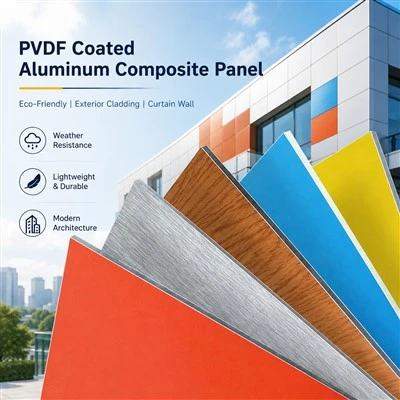
Regarding material selection, the solution emphasizes precise selection based on the usage environment and functional requirements. For different climates and working conditions, aluminum alloy grades and surface treatments with superior weather resistance, such as fluorocarbon coating or anodizing, can be selected to improve resistance to ultraviolet rays, acid rain, and salt spray. In high-temperature or fire-resistant environments, flame-retardant modified core materials or inorganic filler core layers are preferred, and third-party testing verifies the combustion performance rating to ensure compliance with building fire codes. For large-span or high-load curtain walls, structural calculations should determine the optimal combination of panel thickness and core material density to avoid deformation or instability due to insufficient strength. Precision control is another key solution. Aluminum honeycomb panels can be cut, bent, and cold-formed, but improper handling can easily lead to edge burrs, coating cracking, or core material crushing. Countermeasures include: using CNC precision cutting equipment and regularly calibrating the cutters; controlling feed speed and cooling conditions; using specialized molds and setting appropriate radii for bending operations; adding padding to the stress surface to prevent panel dents; avoiding weak points in the honeycomb wall during drilling; and using countersunk heads and reinforcement designs to ensure secure installation. Immediate cleaning of debris and dust after processing, along with surface quality inspection, can keep the defect rate extremely low.
Installation adaptation solutions emphasize structural stability and detailed finishing. For large-area curtain walls, adjustable dry-hanging systems are recommended to absorb structural deviations and thermal expansion and contraction stresses; panel joint widths must be uniform; corners and finishing areas should be treated with specialized profiles and sealants or waterproof strips, balancing watertightness and aesthetics. High-altitude operations must adhere to strict safety regulations, and suction cups or soft straps should be used for smooth handling to prevent panel slippage or falls. For irregular or hyperbolic shapes, 3D modeling and springback compensation analysis can be performed in advance, and customized molds can be used to ensure precise molding dimensions.
Long-term maintenance solutions focus on durability and risk control. A regular inspection system should be established, focusing on checking the integrity of the panel coating, the sealing of panel joints, and the tightness of fasteners. Neutral detergents and soft tools should be used for cleaning to avoid damage to the surface from strong acids and alkalis. Local coating damage should be repaired professionally and promptly to prevent the core material from getting damp or oxidizing. In coastal or highly polluted areas, increasing the frequency of cleaning and protection can significantly extend the service life.
In summary, the systematic solution for aluminum honeycomb panels covers four key aspects: scientific material selection, precision processing, robust installation, and continuous maintenance, forming a closed-loop guarantee from design to operation and maintenance. By mitigating material and process risks through targeted measures, not only can the advantages of lightweight, high strength, and functional integration be fully utilized, but the safety, aesthetics, and durability of the project can also be improved, providing a reliable and efficient comprehensive application solution for the construction and industrial sectors.