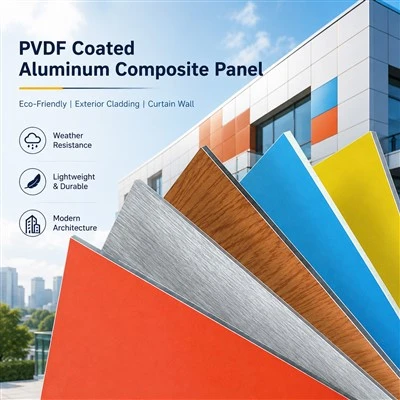
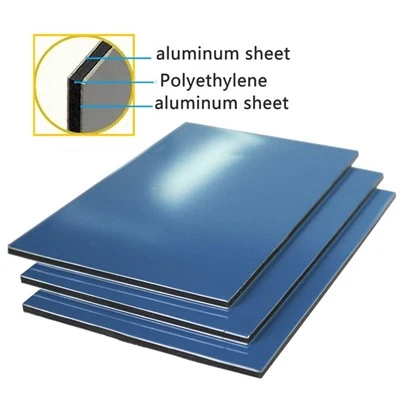
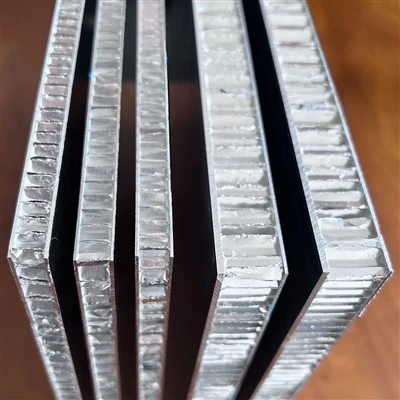
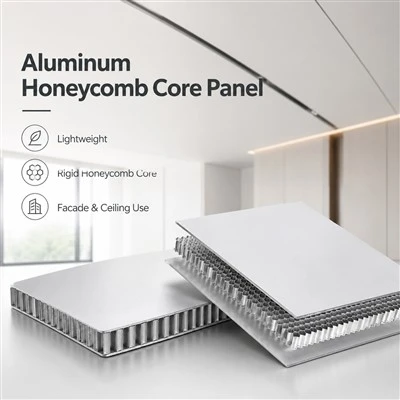
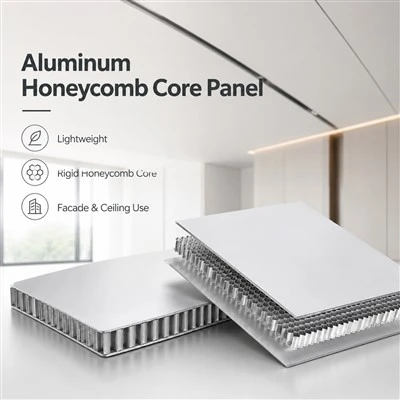
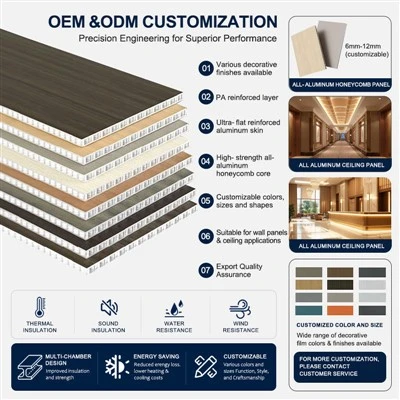
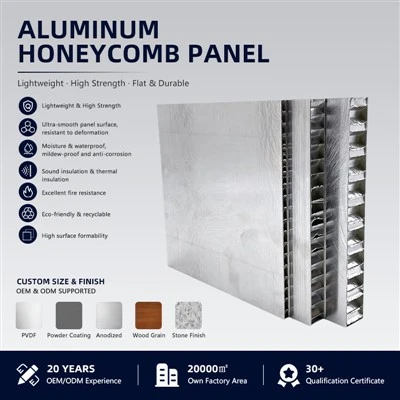
Aluminum honeycomb panels are widely used in curtain walls, interior and exterior decoration, and transportation facilities due to their comprehensive advantages such as lightweight, high strength, excellent flatness, and sound and heat insulation. The quality of their installation directly affects structural safety, appearance, and service life; therefore, scientific methods and standardized procedures must be followed to ensure precise control at each stage.
Preparatory work before installation is fundamental to ensuring smooth construction. First, the panel specifications, quantity, and joint dimensions should be checked against the design drawings. The arriving panels should undergo visual and dimensional re-inspection, discarding any pieces with deformation, coating damage, or dimensional deviations. The installation substrate or keel system should be inspected and corrected to ensure its flatness, verticality, and load-bearing capacity meet design requirements. For large-area or irregularly shaped curtain walls, it is advisable to conduct 3D modeling and detail refinement in advance, clarifying the fixing method and finishing treatment scheme, and preparing a detailed installation sequence and task allocation plan.
The choice of installation method should be based on the actual project and structural characteristics. Dry-hanging is the mainstream process for aluminum honeycomb panel curtain walls. It uses adjustable keels and hangers to fix the panels to the building structure, offering advantages such as detachability and easy maintenance. During installation, the panel positions are first marked on the keel. Special hangers and bolts are used to connect the panels to the keel, and adjustment devices are used to correct the panel flatness and joint width. To ensure water tightness, foam rods or sealing gaskets are used to fill the panel joints, and weather-resistant sealant is applied to the outside. The sealant joints should be uniform, straight, and free of air bubbles. Adhesive bonding is mostly used for interior walls or ceilings. A high-strength adhesive compatible with the panels must be selected. The substrate should be clean, dry, and free of oil. After applying the adhesive, apply even pressure and fix until the adhesive cures to prevent displacement or hollow areas. The slot fixing method is suitable for the rapid assembly of standardized panels. Tenon and mortise slots and limiting pins are used to achieve panel positioning and connection, resulting in high construction efficiency and neat panel joints.
During installation, it is crucial to pay close attention to the control of thermal expansion and contraction and structural deformation. Although aluminum honeycomb panels have good rigidity, they can still experience expansion and contraction stresses due to temperature changes or large-area continuous installation. Expansion joints or movable nodes should be installed within a certain length range to prevent panel deformation or joint cracking. For hyperbolic or irregular shapes, springback compensation and mold correction should be performed beforehand, and adjustable supports should be used to level each panel individually during installation to ensure natural transitions and overall harmony. High-altitude operations must strictly adhere to safety regulations, using stable working platforms and protective equipment. When handling panels, suction cups or soft straps should be used for multi-point force application to prevent slippage or falls.
The finishing work after installation is equally crucial. A comprehensive inspection of panel flatness, joint width, and sealing quality should be conducted, and any minor deviations should be fine-tuned promptly. Residual stains and protective film on the panel surface should be cleaned, and any localized dents or damage should be marked and repaired. An installation quality file and traceable records should be established to facilitate future maintenance and problem identification.
Overall, the installation of aluminum honeycomb panels is a systematic project integrating measurement and positioning, structural fixation, detailed finishing, and safety protection. Only by strictly adhering to technical specifications in the preparation, process selection, process control and finishing stages can its advantages of being lightweight, high-strength and aesthetically pleasing and durable be fully utilized, providing a solid, reliable and exquisitely elegant finishing effect for buildings and engineering projects.